Table of Contents
- Quick Answer
- Why Secondary Packaging Matters More Than You Think
- Box Styles Explained: Which Type Fits Your Brand
- Materials and Board Weights
- Print Finishes That Elevate Perfume Packaging
- What Information Must Go on the Box
- How to Size Your Box Correctly
- MOQ, Lead Times, and Budgeting for Small Runs
- Common Mistakes When Ordering Perfume Boxes
- Box Ordering Checklist
- Frequently Asked Questions
- Conclusion
Quick Answer
Most indie fragrance brands start with a straight-tuck folding carton - a simple, cost-effective box that is printed flat and assembled by hand or machine. It works for standard 30ml to 100ml bottles, keeps MOQs manageable, and prints well. As your brand grows and margin improves, you can move into rigid boxes, drawer boxes, or premium gift formats. Whatever style you choose, every perfume box must include your brand name, fragrance name, volume, ingredients, batch code, and country of origin at minimum. Getting these details right from the start saves expensive reprints later.
Why Secondary Packaging Matters More Than You Think
A lot of new fragrance founders focus almost entirely on the perfume bottle and the label. The box gets treated as an afterthought - something to figure out once everything else is sorted.
That is a mistake that costs real money.
Secondary packaging - the box that holds the bottle - is the first physical thing your customer sees before they even touch the fragrance. At a market stall, on a retail shelf, inside a gifted parcel, or during an unboxing moment shared on social media, the box is doing a huge amount of work for your brand before the scent has even left the bottle.
Beyond aesthetics, the box also provides structural protection during shipping. A perfume bottle without a properly fitted box is far more likely to arrive damaged. Foam pouches and bubble wrap can help, but a well-constructed fitted box is always more reliable.
And practically speaking, the box is where a large portion of your required product information lives. Labels on a 30ml bottle can only hold so much text. The box carries the overflow - ingredients, batch numbers, contact details, safety symbols, and more.
Getting your box right is not optional. It is one of the core decisions in launching a fragrance product.
Box Styles Explained: Which Type Fits Your Brand
There are several common box formats used in the fragrance industry. Each has different cost profiles, MOQ requirements, and brand implications.
Straight-Tuck Folding Carton
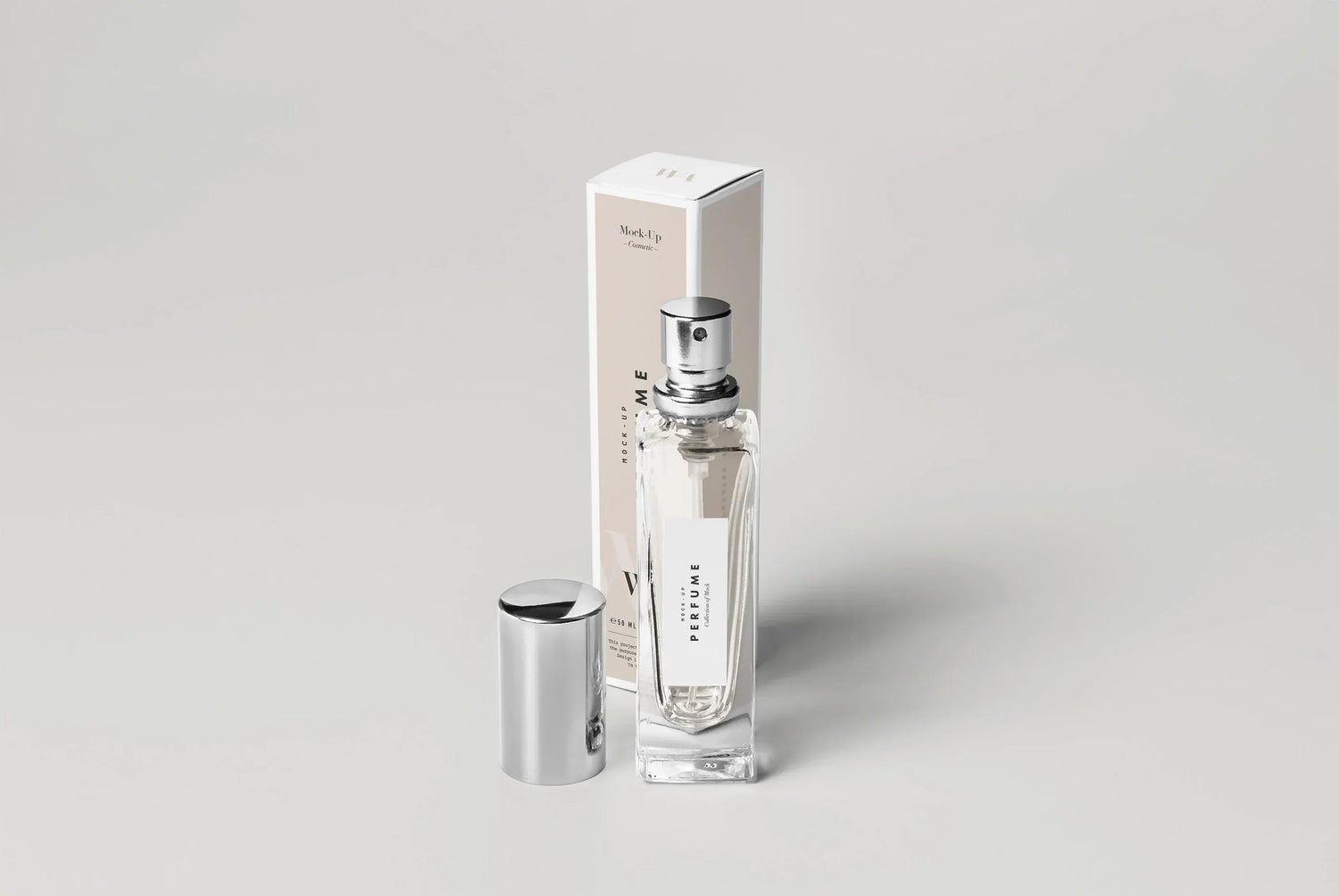
This is the most common box used by small and mid-size fragrance brands. It is a flat-printed paperboard box that is die-cut, scored, and folded, with both the top and bottom flaps tucking in from the same direction. It assembles easily by hand and works well for bottles between 30ml and 100ml.
Folding cartons are printed in flat sheets, which keeps tooling costs manageable. MOQs typically range from 250 to 1,000 units depending on the printer. This is the most practical starting point for a first launch.
Reverse-Tuck Folding Carton
Similar to a straight-tuck box but with the top flap tucking from front to back and the bottom flap tucking from back to front. This creates a slightly more secure closure and is used when the product needs a firmer fit. It is fractionally more expensive to produce than straight-tuck but still within the budget of small brands.
Rigid Box (Set-Up Box)
Rigid boxes are made from thick greyboard covered with printed or wrapped paper. They do not fold flat - they arrive fully assembled. The feel is noticeably premium: firm sides, clean edges, and a weight that communicates quality before the box is even opened.
Rigid boxes are standard at the luxury end of the fragrance market. They are more expensive per unit (often 3x to 6x the cost of a folding carton), have higher MOQs, and take longer to produce. For indie brands just starting out, they are often not the right first move unless your price point is high enough to absorb the cost. At $150 or above per fragrance, the investment makes sense. At $40 to $60, it is hard to justify on early runs.
Drawer Box (Slide Box)
A drawer box has an outer sleeve and an inner tray that slides out horizontally to reveal the bottle. The reveal moment is deliberate and theatrical - it works well for gift-focused fragrances and creates the kind of unboxing experience that gets shared on social media.
Drawer boxes sit between folding cartons and rigid boxes in terms of cost and complexity. They require careful sizing to ensure the inner tray slides smoothly without being loose or too tight. They are a strong option for premium gift sets or limited-edition launches.
Gatefold (Double-Door) Box
A gatefold box opens from the center like a pair of doors, revealing the bottle inside. It is visually dramatic and works well for collector editions or high-end launches where the opening experience is part of the brand story. Gatefold boxes are almost always rigid construction, which means higher cost and production complexity. Best reserved for special releases rather than everyday packaging.
Tube Box
Cylindrical paperboard tubes are occasionally used for perfume packaging, particularly for brands with a distinctive visual identity built around circular or geometric forms. They are unusual enough to stand out on a shelf but can create challenges for display and stacking. Not the most practical starting point, but worth considering if the form genuinely fits your brand.
Materials and Board Weights
The material your box is made from affects its feel, print quality, durability, and cost. Here are the main options.
Solid Bleached Sulfate (SBS)
SBS board is the standard material for cosmetic and fragrance folding cartons. It is white on both sides, which means vibrant printing on the outside and a clean interior. Board weights typically range from 250gsm to 400gsm. Heavier weights feel more substantial in the hand. For perfume cartons, 300gsm to 350gsm is a common choice that balances rigidity with cost.
Kraft Board
Kraft board has a natural brown texture and is associated with eco-friendly and artisan brand aesthetics. It prints well with spot colors and earthy palettes but does not reproduce full-color photography as cleanly as SBS. If your brand identity leans toward natural, sustainable, or minimal, kraft is a strong visual choice. It also tends to cost slightly less per unit.
Greyboard (Chipboard)
Greyboard is the thick, dense material used as the core structure of rigid boxes. It ranges from 800gsm to 1,500gsm and is wrapped with a printed or plain outer paper. It is not used for folding cartons - its role is purely structural in rigid and drawer box formats.
Print Finishes That Elevate Perfume Packaging
The surface finish you choose changes how your box feels and how it reads visually. These finishes are applied after printing and add cost per unit - but the right finish can meaningfully raise perceived quality.
Matte Lamination
A flat, non-reflective surface that is tactile and soft to the touch. Matte lamination is extremely popular in premium fragrance packaging because it reads as sophisticated and understated. It also hides fingerprints better than gloss.
Gloss Lamination
A shiny, reflective surface that makes colors appear more vivid and saturated. Gloss works well when you want your packaging to stand out under retail lighting but can feel more mass-market compared to matte. Common in affordable fragrance lines.
Soft-Touch Lamination
A premium version of matte lamination with a velvety texture. Soft-touch is more expensive but the tactile difference is noticeable - it feels luxurious in a way that standard matte does not. Used by many fine fragrance and niche perfume brands.
Spot UV Coating
A clear gloss varnish applied selectively over specific areas of the design - often a logo, a pattern, or a brand name. The contrast between a matte background and a glossy spot adds visual depth and sophistication. Works particularly well on dark or neutral packaging.
Foil Stamping (Hot Foil)
Metallic foil pressed onto the box using heat and pressure. Gold, silver, rose gold, and copper foils are commonly used in perfume packaging to add a luxury feel. Foil stamping has a tooling cost (a custom die is required) but the visual result is hard to replicate with printing alone.
Embossing and Debossing
Embossing raises a design element above the surface of the board. Debossing presses it down. Both create a three-dimensional texture that is felt as much as seen. Often used on logos and brand names. Like foil stamping, embossing and debossing require a custom die, which adds setup cost.
What Information Must Go on the Box
Perfume boxes carry both commercial and regulatory information. Getting this right is important - both to meet legal requirements in your target markets and to avoid reprinting an entire run of packaging.
The following is a practical guide to what must or should appear on a perfume box. Requirements vary by market, so always verify against the specific regulations for your region.
Required on Almost Every Market
- Brand name and fragrance name - clearly legible on at least one panel
- Net volume - for example "50 ml" or "1.7 fl oz" depending on your market
- Concentration designation - Eau de Parfum, Eau de Toilette, Extrait, Parfum, etc.
- Country of origin - where the product was manufactured
- Responsible party details - the brand name and address of the company placing the product on the market
- Batch code - a production code that allows the batch to be traced if needed
- Best before or period after opening (PAO) - typically shown as a jar symbol with a number and "M" for months (e.g., 24M)
Required for EU / UK Markets
If you are selling in the European Union or the United Kingdom, the EU Cosmetics Regulation (EC No 1223/2009) and its UK equivalent require additional elements:
- Full ingredient list (INCI names) in descending order of concentration, with fragrance components listed as "Parfum" or "Aroma" except for 26 allergens that must be named individually if present above threshold levels
- CLP hazard symbols and warnings if the fragrance contains classified hazardous substances
- A "nominal quantity" declaration
For detailed EU cosmetics labeling requirements, refer to the European Commission's cosmetics labeling guidance.
Required for US Market
The US FDA regulates fragrance as a cosmetic. Under the Fair Packaging and Labeling Act (FPLA), your box must include the net quantity of contents in both US customary and metric units, and the name and place of business of the responsible party. Full ingredient disclosure on the principal display panel is not required for fragrance products under current FDA rules, though this has been subject to regulatory discussion. For current FDA cosmetic labeling guidance, refer to the FDA Cosmetics Labeling Guide.
IFRA Compliance
The International Fragrance Association (IFRA) publishes guidelines on safe usage levels for fragrance ingredients. While IFRA compliance itself does not mandate specific box labeling, many brands include a statement confirming their fragrance complies with IFRA standards. For guidance, see the IFRA Standards Library.
How to Size Your Box Correctly
This is where many first-time orders go wrong. A box that is even a few millimeters too large will allow the bottle to move around and can result in breakage. A box that is too tight may crack during assembly.
To size your box correctly, you need to measure your actual, filled bottle - not the technical specification from the bottle supplier. Measure the widest point of the body, the base dimensions, and the total height including the cap.
Build in a tolerance of approximately 2mm to 4mm on each dimension for a snug but not tight fit. If your bottle is irregularly shaped (round, oval, or tapered), account for the widest cross-section and the height at the tallest point.
If your box will include an insert (foam pad, cardboard tray, or molded pulp inlay), calculate its compressed thickness and deduct that from the available interior space before finalizing box dimensions.
Always request a sample or blank mockup from your box supplier before approving a full production run. This is a standard step that costs very little but saves significant expense if sizing is off.
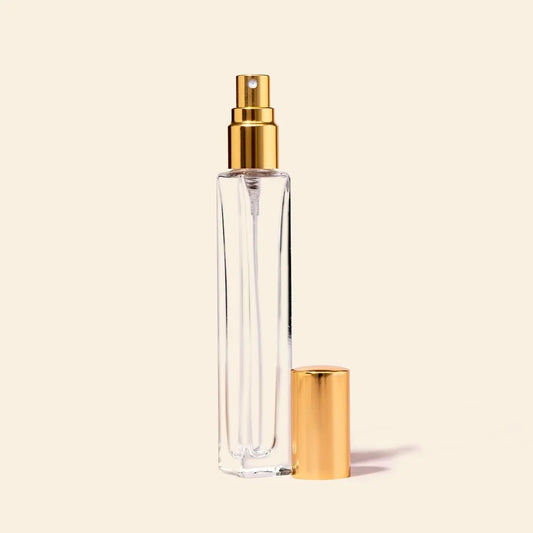
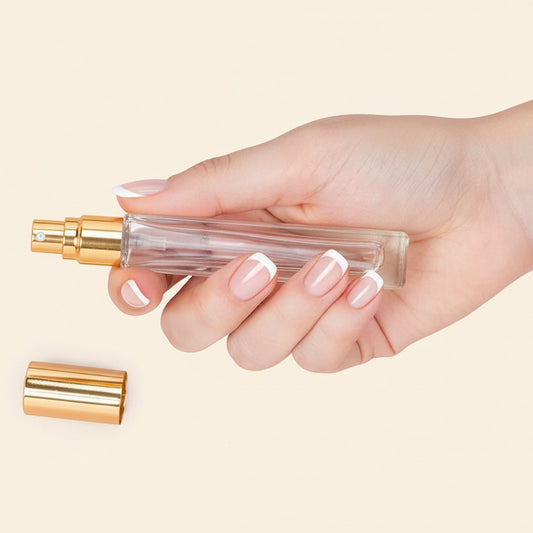
You can find perfume bottle dimensions in the Packamor bottle collection to help match your bottle before ordering boxes.
MOQ, Lead Times, and Budgeting for Small Runs
Minimum order quantities for custom printed folding cartons typically start at 250 to 500 units for digital printing and 500 to 1,000 units for offset printing. Rigid boxes and more complex formats usually have higher minimums - often 500 units or more - because tooling and setup costs are proportionally higher.
Digital printing has made small runs much more accessible in recent years. The per-unit cost is higher than offset at scale, but for a first run of 300 to 500 units it is often the more sensible option. You avoid committing to a large inventory of packaging before you know how your product sells.
Lead times for custom printed folding cartons typically run 2 to 4 weeks from approved artwork. Rigid boxes, drawer boxes, and formats with specialist finishes like hot foil or soft-touch lamination may require 4 to 6 weeks. Account for this when planning your launch timeline - packaging is consistently the longest lead-time item in a fragrance launch, and delays here push everything back.
When budgeting, plan your packaging cost as a percentage of your product cost. A common target for indie fragrance brands is to keep total packaging (bottle, box, label, cap) at 20% to 30% of retail price. At a $60 retail price, that means $12 to $18 per unit for all packaging combined. At that budget level, a folding carton with a standard lamination finish is realistic. Rigid boxes typically add $3 to $8 per unit, which requires a higher retail price to remain viable.
Browse Packamor's perfume box collection to compare styles and request samples before committing to a production run.
Common Mistakes When Ordering Perfume Boxes
Not requesting a physical sample before production
A PDF proof shows you colors and layout, but not how the box actually feels, opens, or holds the bottle. Always request a physical sample - either a printed sample or a blank structural mockup - before approving a full run. A box that looks great on screen but is 5mm too wide or uses board that is too thin to stay closed will cost far more to fix after production than before it.
Ordering before the bottle is finalized
The bottle dimensions must be confirmed and tested before the box is sized. Switching bottle suppliers mid-launch - even to a seemingly similar bottle - can render an entire print run unusable if the dimensions are different. Finalize your bottle selection first, measure it with actual fragrance inside, then order boxes.
Forgetting required regulatory information
It is easy to focus on the visual design and overlook mandatory labeling. Running out of space for an ingredient list or batch code after the design is already set leads to either an illegal label or a costly reprint. Build your regulatory requirements into the brief before design begins, not after.
Choosing a finish that conflicts with your printing method
Some specialty finishes, such as foil stamping and embossing, require specific setups and are not compatible with all digital printers. Confirm your supplier can deliver the finish you want before committing to a design that depends on it.
Underestimating lead times
Custom boxes always take longer than expected. If you are targeting a launch date, work backwards from that date and build in at least 6 to 8 weeks for packaging production and delivery. Launches that slip because boxes are still in production are one of the most avoidable delays in the fragrance industry.
Ignoring box sustainability for your target audience
Sustainability is increasingly important to fragrance consumers, particularly in premium and indie market segments. If your target customer cares about sustainability, a recyclable or FSC-certified kraft board box may actually strengthen your brand story. Ignoring this consideration when your customers clearly care about it is a missed opportunity.
Box Ordering Checklist
- Bottle dimensions confirmed (width, depth, height including cap) with actual filled bottle
- Box style selected (folding carton, rigid, drawer, or other)
- Board material chosen (SBS, kraft, or other)
- Board weight specified (e.g., 350gsm for SBS folding carton)
- Print finish confirmed (matte, gloss, soft-touch, spot UV, foil)
- All regulatory information included in brief (volume, batch, PAO, ingredients, country of origin, responsible party)
- Insert or padding method decided and dimensions accounted for in box sizing
- Physical sample or blank mockup requested before approving production
- Print-ready artwork files supplied in the correct format (usually PDF with 3mm bleed)
- MOQ confirmed and stock quantities ordered in relation to expected sales
- Lead time confirmed against your launch date with adequate buffer
- Barcode placement included if selling through retail or wholesale channels
Frequently Asked Questions
Do I need a box for my perfume?
Technically, no - some brands sell their fragrance in a standalone bottle with a label only. But a box provides structural protection, carries required regulatory information that may not fit on a small bottle label, and significantly affects perceived value. Most customers expect a box when purchasing a perfume product. For retail and wholesale channels, a box is almost always required.
What is the cheapest type of perfume box for a small brand?
A straight-tuck folding carton printed on SBS board with a matte or gloss lamination finish is the most cost-effective option for small brands. Digital printing allows runs as low as 250 units. Kraft stock with a printed label affixed is an even lower-cost option for very small batches or test runs, though it limits your design options.
How do I know what size box to order?
Measure your filled, capped bottle - width at the widest point, depth, and full height. Add 2mm to 4mm tolerance on each dimension. If you are including an insert, account for its thickness. Always confirm sizing with a physical mockup before production.
Can I order boxes and bottles from the same supplier?
Yes, and doing so can simplify logistics significantly. Packamor supplies both perfume bottles and perfume boxes, which makes it easier to match dimensions, plan production timelines, and reduce shipping complexity at the sample and bulk order stage.
What is the minimum order quantity for custom perfume boxes?
Digital print runs can start from around 250 units. Offset printing typically starts at 500 to 1,000 units and becomes more cost-effective at higher volumes. Rigid boxes and specialist formats usually have minimums of 500 units or more due to their higher setup costs.
Should I put ingredients on the box or on the label?
Both is ideal. For markets requiring full INCI ingredient listing (EU and UK), the box typically carries the full list because the space on a perfume bottle label is usually too limited for a complete ingredient declaration. The bottle label carries the essential identification information (name, volume, concentration), and the box carries the full regulatory detail.
Conclusion
Perfume box packaging is not a design decision bolted onto the end of a launch - it is a core part of your product and your brand experience. Getting the style, materials, sizing, and information right before you go into production will save you from reprints, fitment problems, and regulatory issues that cost far more to fix after the fact.
Start with a straight-tuck folding carton if you are in your first launch phase. Focus on quality board weight, a finish that suits your brand aesthetic, and getting all required information onto the box before design is finalized. Request a physical sample before approving production. Build in lead time that accounts for the reality that packaging almost always takes longer than planned.
As your brand grows and your retail price supports it, you can invest in more premium formats - rigid boxes, drawer styles, soft-touch finishes, and foil details - that elevate the unboxing experience and justify a higher shelf price.
Browse the Packamor perfume box range and perfume bottle collection to find packaging components that work together for your brand. If you need guidance on sizing or matching bottles to boxes, the Packamor team can help you get it right before you commit to production.